
AI in Everyday Compliance: How Intelligent Support Is Changing Operational Review Processes
Regulated companies today face a dual challenge: requirements for compliance, anti-money laundering and risk management are continuously increasing, while operational teams must assess ever larger volumes of data, transactions and suspicious activity. In highly regulated industries in particular, it is no longer sufficient to map review processes solely through rigid rules and manual case-by-case handling.
Modern compliance work requires systems that relieve analysts, make connections visible more quickly and filter relevant cases from a large number of alerts. This is precisely where insic comes in with AI-supported assistance in everyday compliance operations.
From Rule-Based Checks to Intelligent Case Assessment
Traditional compliance systems often operate on a rule-based basis. They check defined thresholds, fixed parameters or predefined risk indicators. This logic remains important, but reaches its limits where patterns become more complex, data sources need to be combined or suspicious activity does not clearly fit an existing rule.
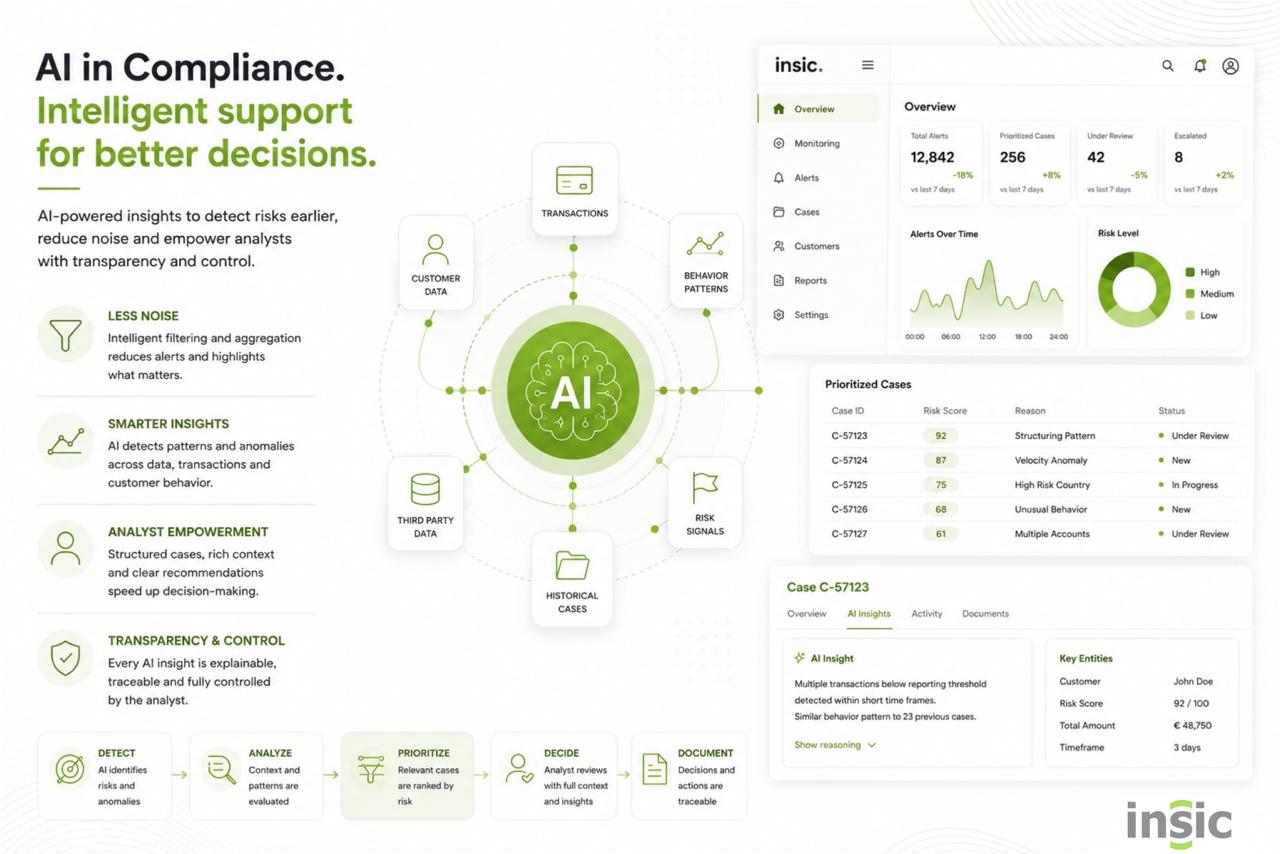
AI can meaningfully complement these processes. It recognizes patterns, condenses information and helps analysts identify relevant indicators more quickly. The aim is not to replace human decisions. Instead, the review process becomes more structured, more efficient and more robust.
insic’s AI stack is directly integrated into operational compliance and monitoring processes. Suspicious patterns can be identified at an early stage, anomalies can be detected using freely formulated search queries and cases can be prioritized according to relevance. As a result, analysts no longer have to assess every technical alert in isolation, but can focus more strongly on evaluating genuinely relevant matters.
Less Noise, More Relevant Cases
A central problem in many monitoring processes is the high number of alerts. Not every anomaly automatically represents a risk. At the same time, relevant indicators must not be overlooked. For compliance teams, this creates a tension between efficiency, diligence and regulatory responsibility.
AI-supported analysis helps manage this tension more effectively. Indicators can be aggregated, comparable cases can be combined and suspicious developments can be presented in a prioritized manner. Many individual signals are transformed into a structured case that can be understood faster and processed more precisely.
This not only improves the speed of work, but also the quality of the decision-making basis. Analysts gain a better overview of connections, histories and potential escalation points.
Traceability Remains Essential
Especially in regulated environments, AI must not become a black box. Every assessment must remain explainable, particularly when it leads to operational decisions, escalations or further review measures.
For this reason, insic places great importance on transparent and traceable AI support. Assessments are justified, relevant connections are documented and escalation paths can be traced graphically. The analyst remains in control of the final assessment at all times.
AI therefore does not replace compliance expertise. It becomes a tool that makes this expertise more usable. The decision remains with the human expert. The analysis becomes faster, more structured and more consistent.
Practical Benefits for Regulated Companies
For regulated companies, AI in everyday compliance primarily means operational relief. Review processes can be made more efficient, resources can be deployed more precisely and relevant risks can be identified earlier. At the same time, decisions can be documented more effectively and justified transparently to internal or external auditors.
This approach is particularly valuable where large volumes of data, recurring review processes and strict regulatory requirements come together. AI can help strengthen existing compliance structures without the need to completely rebuild established control mechanisms.
Conclusion
AI in compliance is neither an end in itself nor merely a future topic. When used correctly, it already supports operational teams today in assessing large volumes of data more effectively, identifying relevant cases more quickly and documenting decisions more transparently.
For insic, one principle is central: technology should not make compliance work more complicated, but more effective. The combination of intelligent analysis, transparent reasoning and human decision-making expertise creates the foundation for exactly that.
Related Blogs

insic Blog – Compliance Solutions
insic presents technical solutions for implementing the legal requ....
28 Apr, 2025
Read More

insic basic module
The insic basic module provides central functions for managin.....
28 Apr, 2025
Read More


insic provides trusted compliance solutions for youth protection, player safety, and anti-money laundering.
Sitemap
© All Rights Reserved By insic 2025
Adding {{itemName}} to cart
Added {{itemName}} to cart